Tag Archive for: April 1968

On April 2, 2018, at the George Washington University Museum “Mondays at the Museum” series, Ted Gong and the 1882 Foundation presented Penny Lee’s film, Through Chinatown’s Eyes: April 1968. The timing of this screening aligned with the week of the historic 50th anniversary of the civil unrest in the District following Dr. Martin Luther King’s assassination. After the screening, the group, some of whom are regulars to the Mondays at the Museum series, asked engaging questions, both about the specific community tensions raised in the film as well as more general questions about the Chinese immigration to the United States and how the 1882 Chinese Exclusion acts fit in. Thanks to all who joined us for this event!

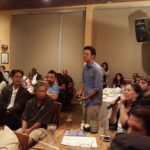
Screening of “Through Chinatown’s Eyes: April 1968” at Mondays at the Museum at the GWU Museum

1882 Foundation Executive Director Ted Gong leads the group in an engaging discussion on race, civil rights, immigration and citizenship.

By Georgetown University’s Political Awareness Committee of the Asian American Student Association

On February 21, 2017, Georgetown University’s Political Awareness Committee (PAC) of the Asian American Student Association (AASA) screened the 1882 Foundation documentary, “April 1968: Through Chinatown’s Eyes,” to an audience of 80 Georgetown undergraduates from all cultural, racial and ethnical backgrounds.

After the screening, the students engaged in an informative and captivating conversation with guest panelists. Ted Gong, the director of the 1882 Foundation, briefly introduced the documentary series project and described how the Asian American community had its own historical arc running parallel to the broader Civil Rights Movement, with landmarks such as the Immigration and Neutrality Act of 1965. Other panelists included Lisa Mao, the producer of the documentary, Harry Chou and Stan Lou, who were interviewed in the documentary, and Easten Law, a Georgetown Chaplain-in-Residence who moderated the discussion.

After each panelist shared her or his own connection to the documentary and the events of April 1968 in D.C.’s Chinatown, they took questions from the audience. A sophomore asked how solidarity could be fostered in the absence of geographical vicinity. A freshman questioned whether the panelists personally knew members of Asian American community in D.C. who participated in the movement to support the African American minority in 1968.

The event lasted for an hour and a half, and many students stayed afterwards to have longer conversations. This event presented Georgetown students with a nuanced angle of the Civil Rights Movement, telling one story of the influence this historical movement had on another minority group who was also marginalized at the time. In the end, many students expressed interest in attending more events on this perspective in the future.

2017-georgetown-april-1968-group-photo

The latest presentation of “Through Chinatown’s Eyes, April 1968” occurred at the National Council for the Social Studies Annual Conference held in Washington, DC on Dec. 2, 2016. Ting-Yi Oei showed the film to 30 teachers and other educators and provided them with a copy of the film and a lesson plan. The lesson plan covers not just the events documented in the film but provides valuable context for the history of the times. Civil rights are at the heart of the events surrounding Martin Luther King’s assassination, but the riots that followed should also be seen in the entirety of what was going on in the country at the time: the Vietnam War, a divisive presidential campaign, and a pervasive sense of social injustice. The film also raises questions about the search for identity as is evident by the accounts given by the residents of Chinatown who lived through the riots. The lesson plan addresses these issues and more so that teachers can incorporate the film into a number of places in the curriculum and meet national standards in courses ranging from civics and government, to history, and to sociology. Several teachers commented on the first-person stories that people told of the experiences, and many were unaware that the riot took place in an area where another minority group lived. Another teacher who is from DC noted that the film is also valuable in showing how neighborhoods are transformed over time and that it can be very effectively used in a contemporary fashion comparing what the area looks like today to what it was in 1968 and in between.

Through Chinatown Eyes April 1968 Image

The lesson plan is available here.


April 1968: Understated Intersections of Race and Place
by Easten Law

[Easten Law is a former lecturer in Intercultural Relations at American University in Washington DC. He is now D.C. Commissioner for API Affairs in the DC Mayor’s office and a doctoral student at Georgetown University.]

It was a real privilege moderating the 1882 Foundation screening and discussion of “Through Chinatown Eyes: 1968” at Busboys and Poets in early October. I was truly humbled to hear the stories of my Chinese-American elders. Their witness is vital for all Washingtonians seeking to make sense of the strange phenomenon of D.C.’s Chinatown, where a gleaming archway and neon translations of Western restaurant chains can blind us to the remaining authenticity that lingers. As Washington, D.C., continues to change, these stories become all the more important.

Penny Lee and Lisa Mao’s documentary is a little jewel of a project for its understated yet profoundly inter-sectional angle on a watershed moment in American history. There are lots of different resources that independently address Asia-American identity and history, D.C. history, or the 1968 riots in particular. However, there are few, if any, that address them together in such a way that invites one to make connections between them. This film provides tangible bridges for understanding how the negotiation of Asian-American identity, race relations, and urban dynamics overlap and influence one another. There is a real need for more films of this nature, works that display complexity through diverse voices anchored in a common event, even if that event is experienced in very different ways.

The audience was a wonderfully diverse group – from long time African-American Washingtonians to young Asian-American students and activists new to D.C. The discussion was both inter-generational and interracial.  Themes of neighborly kindness, community building, and shared histories of civil rights emerged out of painful, complex memories. For many, this was the very first time they had heard anything about the riots from a Chinese-American perspective. The film encouraged a beautiful dialogue that acknowledged one another’s contributions to civil rights even as it recognized what is still undone.

If you weren’t able to come out to the documentary viewing, let us know and we’ll keep you up to date. We are looking for new venues to show it again in the upcoming months.

If you are a teacher, the 1882 Foundation is happy to provide a copy for educational purposes. At a compact 25 mins, the film allows space for good follow up discussions in the classroom. There is also a rough curriculum available for those seeking ideas on how to teach to the film from an historical lens.

Easten Law facilitated film screenings and community discussions at the Chinese Community Church in Chinatown DC and at Busboys and Poets in Columbia Heights.

Next screening and community discussion is scheduled for May 2016 at the Smithsonian Community Museum.  Watch for exact dates and times at our Activities and Events tab, or join our Talk Story mail list at http://1882foundation.orgbit.ly/TalkStoryList.

Through Chinatown Eyes April 1968 ImageThrough Chinatown’s Eyes First Episode: April 1968

The first in a series of short documentaries, April 1968, examines the impact of the civil disturbances and street violence in DC on Chinatown after the assassination of Dr. Martin Luther King in April 1968.  The story, from the perspective of people recalling events as school children and young adults in Chinatown, explores ideas about ethnic identity and race relationships.  It tells how the street violence affected the growth of the neighborhood and its commercial development.

The film was produced by Penny Lee with Lisa Mao.  It is a product of the 1882 Foundations’ DC Chinatown Oral History Project.  The project seeks to record the oral histories of people who have a stake in preserving the history and heritage of DC Chinatown.

In collecting the oral histories (and images related to them), project directors wanted to preserve them as stories related to topics or themes or issues.   Each story will be complete on its own, but together they will tell the history of DC Chinatown from its beginnings to today in a series of episodes that collectively we call “Through Chinatown’s Eyes.”

A grant from the DC Humanities Council determined the first episode.  Under the “Who’s a Washingtonian Grant,” the 1882 Foundation leaders decided to group together memories and stories that dealt with the 1968 street violence and how ethnic neighborhoods interacted or related to one another.

The events of April 1968 were pivotal for Chinatown, as they were for the U Street neighborhood and the rest of urban DC.   As such, April 1968 is a good episode to start the film series.  It delineates a watershed between two time periods to help categorize our stories and conceptualize future episodes.   The first period will collect stories generally about traditional perspectives and legacy Chinatown affiliations.  The second period holds together stories that relate prominently to American acculturation and the fading of old organizations and livelihoods for a community moving decidedly to the suburbs, even as Chinatown still remains meaningful in a cultural sense.

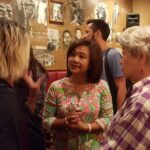
April 1968 Film Producer Penny Lee at screening and community discussion at Busboys and Poets, Columbia Heights DC, October 2015

What that meaning is, as an indicator of the future of Chinatown, becomes a key question to explore.  The question and the effort to articulate answers becomes the purpose of the effort to gather and preserve the stories.

Future episodes of the Through Chinatown’s Eyes series will either go one direction to uncover older history and traditions.  These include episodes about family associations, reasons to settle in DC, original function of Chinatown, daily life and society including the direct consequences of the Chinese exclusion laws and the immediate impact of WWII.  Episodes can go the other direction to examine topics about activities related to American civil rights and participation in mainstream political actions, the evolution of Chinatown businesses, changing youth activities and the gentrification of DC Chinatown.

A list of potential episodes is added below.  We welcome suggestions for others episodes.  Each episode will run no longer than 30 minutes.  Each will have a study guide similar to the one developed for April 1968.  The study guide is important because the mission of 1882 Foundation and this film series is not just to collect and re-tell entertaining stories.  Fundamentally, it is to educate the public about the history of Chinese in America and its continuing and future significance to all Americans.

Suggested episodes:

1.  Gold Mountain Hopes — Why Chinese came to DC Part I:  Patterns and routes from Canton, the Angel Island legacy.  Why DC?

  1. The Promise – About the enabling and protective roles of family associations and traditions seen through the “promise” of care even after death illustrated by Qing Ming rites surrounding DC and Range 99 at the Congressional Cemetery.
  1. Safe Harbors — Why Chinese came to DC Part II: Patterns and routes from North China and Taiwan. The legacy of Yung Wing, the Northeast Chinese university movement, Two Chinas, and Tian An Men, students and professional elites. “the legal 105.”
  1. Community and Youth – Becoming American while holding onto Chinese Community through Church and Youth Club.
  1. Pennies for China and Fighting for America — Choices and Commitments, traditionalism and nationalism to China/patriotism to America.
  1. April 1968 — Choosing to Stay and Defining identity – Done.
  1. The Bean Sprout King – Thriving in Chinatown, building prosperity and family life, living the Dream. Teen dances, radio shows, football cars and beauty queens.
  1. Movable Chinatowns – Pull Factors: Why Chinese leave DC Part I: Opportunities pull away. Capabilities and skills no longer restricted to Chinatown. Once out, why return?
  1. Gentrification – Push Factors: Why Chinese leave DC Part II: Increasing Costs and Rich Real Estates push Chinese out.  Pan-Asian fusion and the rise of the Young Professional
  1. Cultural Touchstone — Lion Dancing, 9-man Volley Ball and Talk Story
  1. Creating a Cultural Destination – Relevancy. Preserving story sites as well as physical sites.  Chinatown as a Museum.  What lies ahead for Chinatown in DC and other Chinatowns.  Pan-Asian-ism as “cultural gentrification.”

In addition to funding provided by the DC Humanities Council, April 1968 received financial backing from the Chinese American Citizens Alliance, the Sino American Cultural Society and OCA.   The 1882 Foundation is a non-profit 501(c)3 organization.
 

Tag Archive for: April 1968

Nothing Found

Sorry, no posts matched your criteria

©2026 1882 FOUNDATION. ALL RIGHTS RESERVED.